
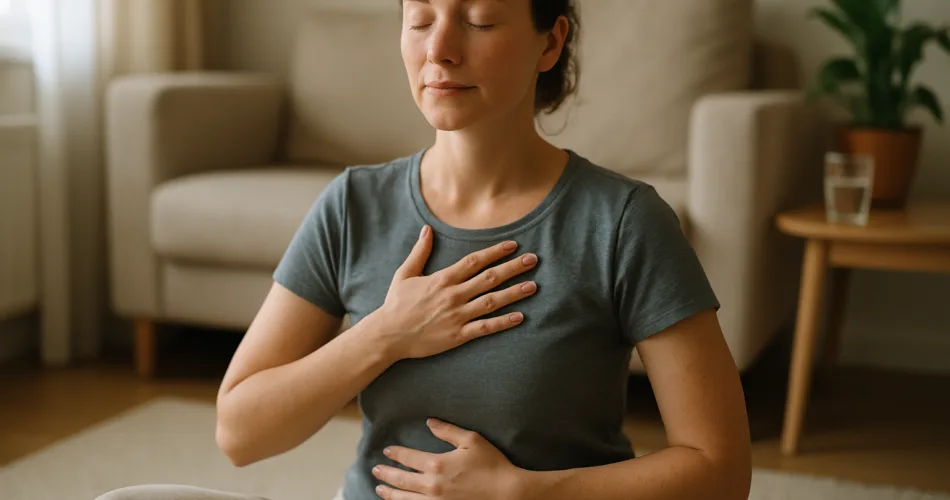
You know that feeling, right? Your chest tightens, your jaw clenches, and your mind starts spinning like a broken ceiling fan. It’s overwhelming. You just want to find some stress relief techniques that actually work. But let’s be real—most advice tells you to meditate for twenty minutes, and who has that kind of time? That’s why the 60-second breathing trick is about to change everything for you. You can literally stop stress in 60 seconds without anyone even knowing you’re doing it.
Honestly, I’ve been there. Like, last week, I was stuck in traffic, late for a meeting, and my heart was pounding out of my chest. I remembered this one trick a therapist once shared, and bam. 60 seconds later, I was calm enough to actually think straight. It’s not magic—it’s just smart biology. And today, I’m gonna walk you through five different breathing exercises for anxiety so you can pick the one that fits your panic mode.
Think of your nervous system like a light switch. Stress flips it to “on.” These techniques? They flip it back to “off.” But here’s the catch—not every method works for every person. Some of us need a quick, sharp reset, while others need a slow, soothing rhythm. So, which one will be your go-to for instant stress relief? Let’s find out.

Why 60 Seconds? The Science of a Quick Reset
You might be thinking, “Can I really calm down fast in just a minute?” The answer is a huge yes, and here’s why. Your body’s stress response is kinda like a fire alarm—it’s loud, fast, and annoying. But your breath is like the fire extinguisher. When you control your exhale, you literally tell your vagus nerve to chill out. That nerve runs from your brain to your gut, and it’s your body’s brake pedal for stress.
A study from Harvard Medical School found that deep, rhythmic breathing can lower cortisol levels by over 50% in just a few minutes. That’s not a typo. 50%. So when you’re looking for breathing techniques for panic, remember that your breath is faster than any pill. It’s always with you, it’s free, and it works almost instantly.
But here’s the kicker—most people breathe wrong when they’re stressed. They take shallow, quick breaths from their chest, which actually makes the panic worse. You’ve gotta breathe from your belly. Like a baby does. Ever notice how a sleeping baby’s tummy goes up and down? That’s the gold standard for stress relief techniques. Now, let’s dive into the five techniques that’ll stop your stress in 60 seconds flat.
Technique #1: The 4-7-8 Breath (The Sleep Doctor’s Favorite)
This one is famous, and for good reason. It was popularized by Dr. Andrew Weil, and it’s like a sedative for your brain. You inhale for 4 seconds, hold for 7 seconds, and exhale for 8 seconds. Sounds simple, right? But the longer exhale is the secret sauce. It forces your heart rate to slow down.
I once met a client who had a massive fear of flying. She used this technique during takeoff, and she told me it was the first time she didn’t grip the armrest till her knuckles turned white. Try it right now. Inhale for 4. Hold for 7. Exhale for 8. Feel that? Your shoulders just dropped an inch. That’s your body saying “thank you.”
Why it works for instant stress relief:
- It activates the parasympathetic nervous system (your rest-and-digest mode).
- It forces you to focus on counting, which distracts your racing mind.
- It’s perfect for nighttime anxiety or when you’re trying to fall asleep.
Technique #2: Box Breathing (The Navy SEAL’s Secret Weapon)
Okay, this one sounds intense, but it’s actually super easy. Box breathing is used by soldiers and first responders to stay calm in extreme situations. Think of it like drawing a square with your breath. Inhale for 4 seconds, hold for 4, exhale for 4, hold for 4. That’s one box. Do it three more times, and you’re done in 60 seconds.
Picture this: You’re about to give a big presentation, and your heart is doing the cha-cha in your chest. Instead of panicking, you just start breathing in a square pattern. No one notices. You look composed. And inside, you’re literally hacking your brain to feel safe. It’s one of the most effective breathing exercises for anxiety because it gives your brain a predictable rhythm.
Here’s a quick stat for you: A 2018 study from the Journal of Medical Internet Research showed that box breathing reduced anxiety symptoms by 35% in just one session. So if you want to calm down fast, this is your jam.
Technique #3: The Physiological Sigh (The Two-Breath Reset)
This one is my personal favorite because it’s ridiculously fast. It’s not even a full minute—it’s like two breaths. You take a deep inhale through your nose, then take another small sip of air on top of that (like you’re trying to inflate a balloon), and then you exhale slowly through your mouth with a big sigh. That’s it. One cycle.
Why does this work? Because the double inhale pops open tiny air sacs in your lungs called alveoli, which are often collapsed when you’re stressed. It’s like unclogging a drain. The long sigh that follows resets your nervous system instantly. It’s actually your body’s natural way to stop stress in 60 seconds—or less!
An analogy for you: Think of it like shaking a soda bottle to release the pressure. The double inhale is the shake, and the sigh is the fizz that lets it all out. Next time you’re stuck in a annoying conversation or a traffic jam, just do one physiological sigh. No one will even bat an eye.
Technique #4: Alternate Nostril Breathing (The Yogic Power Move)
This one might look a little weird, but it’s legit. You use your thumb and ring finger to close off one nostril at a time. Inhale through your left, close it, exhale through your right. Then inhale through your right, close it, exhale through your left. That’s one round. Do three rounds, and you’re at about 60 seconds.
I know what you’re thinking—”Really? That sounds complicated.” But trust me, it’s not. And the payoff is huge. This technique balances the left and right hemispheres of your brain, which is why it’s a go-to for breathing techniques for panic. It’s like hitting the reset button on your emotional state.